Should Your Church Use AI?
A Pastor's Guide to Smart, Safe Ministry Tech.
AI is already in your church — whether you know it or not. Here's how to
use it wisely, what to avoid, and how to protect your congregation's
sacred trust.
You may have seen the posts. "AI is dangerous for churches." "Pastors
shouldn't use ChatGPT for sermons." "Technology is replacing the human
touch in ministry."
And honestly? Some of those concerns are worth taking seriously.
But here's the thing: refusing to think about AI isn't the same as being
safe from it. Your email platform already uses AI to filter spam. Your
social media scheduling tool uses AI to suggest posting times. Sermon
illustration platforms are powered by it. AI isn't coming to your church
— it's already there.
The question was never whether AI would arrive in your ministry.
The question is whether you'll steward it wisely.
The Pope Weighed In — and It's Worth Reading
In May 2026, Pope Leo XIV released an encyclical titled
Magnifica Humanitas (The Grandeur of Humanity), one of the most
thorough treatments of artificial intelligence from a Christian
perspective in our time.
His conclusion wasn't "ban AI." It was something far more nuanced — and more useful:
"In the abstract, technology in and of itself is not a solution to
humanity's problems, just as it is not inherently evil. In practice,
however, technology is never neutral, because it takes on the
characteristics of those who devise, finance, regulate and use it.
Therefore, the primary choice is not between a 'yes' or 'no' to
technology, but rather between constructing Babel or rebuilding
Jerusalem."
— Pope Leo XIV, Magnifica Humanitas, §9
Babel or Jerusalem. A system built for power and control — or a community
rebuilt stone by stone, with shared responsibility and God at the center.
That framing belongs in every church conversation about AI.
It's Like Cake
Cake is wonderful. Truly. But just because I love cake and need to eat to
stay alive doesn't mean I should eat cake for every meal. That doesn't
make cake inherently harmful — it just means eating it without awareness
of how it affects me, short and long term, is unwise.
AI is the same way. Used thoughtfully, it can give your staff hours back
every week, help your pastor go deeper in Scripture study, and reach
people in your community you'd otherwise never connect with. Used
carelessly — pasting a counseling session into a public chatbot,
replacing pastoral care with automation, outsourcing doctrinal judgment
to a language model — it can do real harm.
The answer isn't avoidance. The answer is governance. And to make that
easy, we built a free tool — the
Kingdom Metrics Church AI Governance Tool
— so any ministry team can put a real policy in place today, not someday.
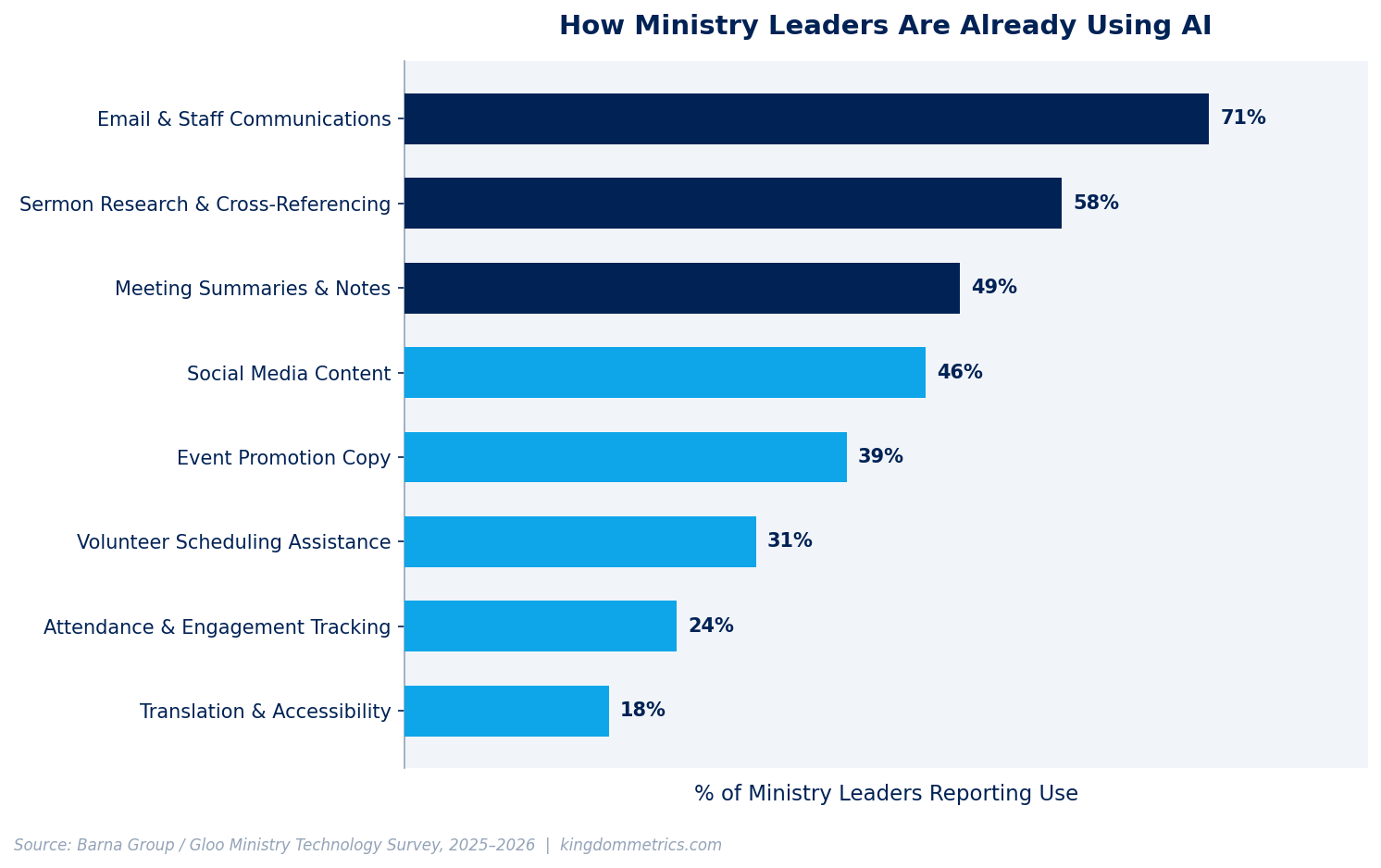
AI Is Already in Your Church — Here's the Data
Source: Ministry technology research, 2025–2026.
More than half of ministry leaders are already using AI for sermon
research. Nearly three-quarters are using it for email and
communications. This isn't a future conversation. It's a present-tense
reality that most churches haven't formally addressed yet.
That gap — between widespread usage and zero formal policy — is exactly
where problems happen.
What Good AI Can Do for Your Ministry
This is the part that gets buried in the fear-first conversation.
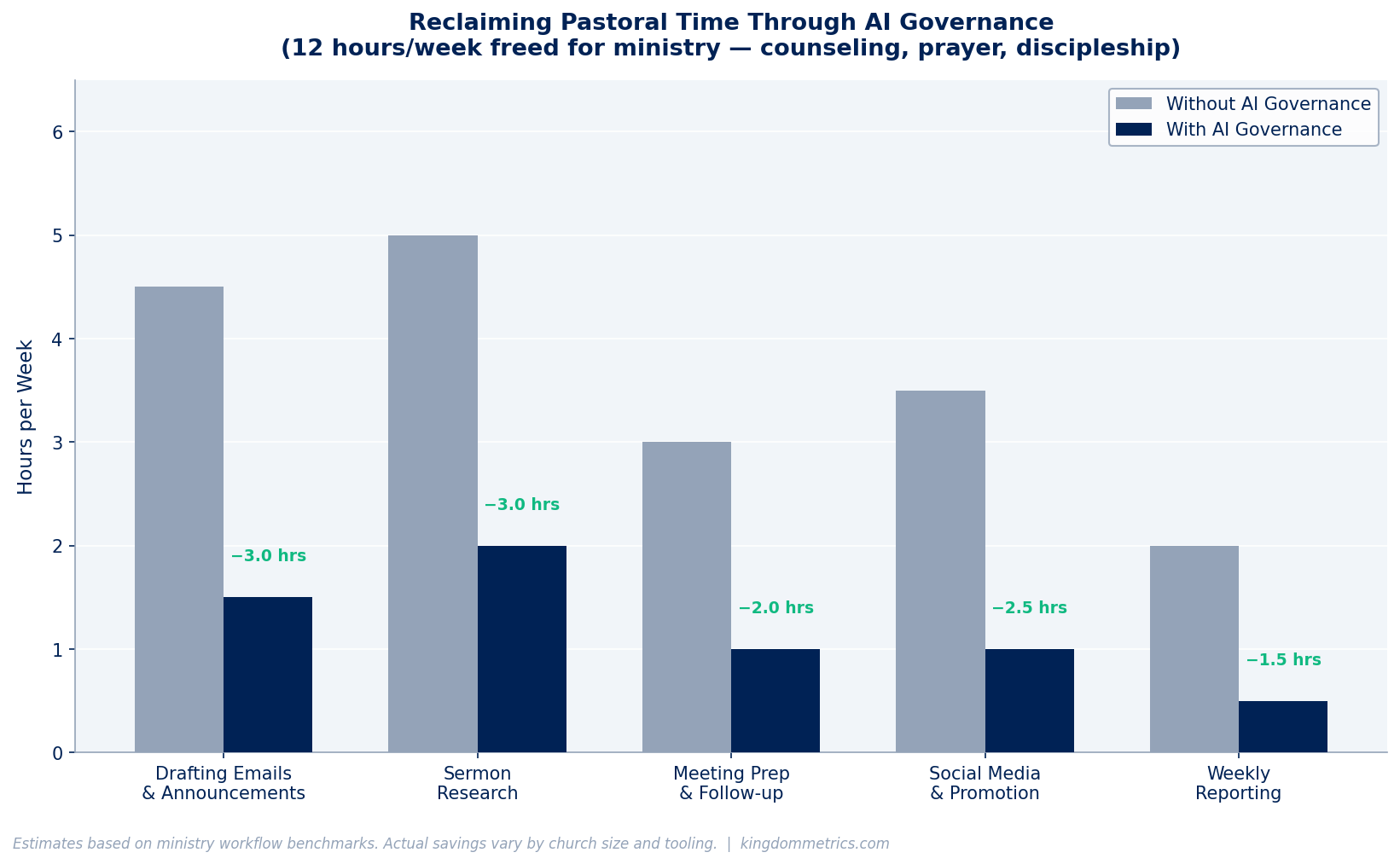
A pastor who spends 5 hours a week on sermon research could compress that
to 2 hours — spending more time in prayer, reflection, and pastoral
engagement with his congregation, not less. A church administrator who
drafts 4 hours of weekly emails could draft them in 90 minutes. A
volunteer coordinator who patches together scheduling could automate the
reminders.
Based on ministry workflow benchmarks. Results will vary by team size and
current tooling.
Twelve hours a week. That's what thoughtful AI governance can return to a
ministry team — not to scroll social media, but to do the things AI
cannot do: sit with a grieving family, disciple a new believer,
pray with a prodigal's parent.
"AI is a tool for the management of ministry, never for the ministry of
ministry."
What AI Should Never Touch in Your Church
Not everything is appropriate for AI. Some things should be firmly off
limits:
Prayer requests and counseling notes should never
enter a public AI system. These are sacred trust data. Period.
Pastoral care and spiritual direction cannot be
replaced by a chatbot. Full stop.
Doctrinal discernment requires a human being who has
studied, prayed, and been formed by the Spirit — not a model trained on
the internet.
Giving records and personal financial data should
never be processed through consumer AI tools without explicit security
and privacy protections.
As Pope Leo XIV writes, AI "does not undergo experiences, does not possess
a body, does not feel joy or pain, does not mature through relationships
and does not know from within what love, work, friendship or
responsibility mean." It can draft your bulletin. It cannot shepherd your
flock.
What Governance Looks Like in Practice
AI governance for a church isn't a 200-page policy document. It's a clear
framework your staff can actually use — and we've already built it for
you. The
Kingdom Metrics Church AI Governance Tool
is free, customizable with your church name, and printable for staff
distribution. It walks you through the three foundational steps:
1. Appoint an AI Steward
One staff member owns the question: How is our church using AI, and
is it consistent with our values? They don't have to be a tech
expert. They have to be trustworthy and willing to ask hard questions.
🟡 Use with Caution
Visitor follow-up automation, sermon feedback tools, volunteer
recruitment messaging — anything where pastoral judgment should review
before sending.
🔴 Off Limits
Member data in public AI, counseling notes, giving records, anything
involving minors' personal information.
3. Review Annually
AI is moving fast. Your policies should be living documents, not laminated
ones.
We Built the Tool. It's Free. Use It Today.
The Kingdom Metrics Church AI Governance Tool gives your ministry
everything it needs to put policy in place right now: an AI Tool Registry,
Policy Framework, department-specific guidelines, an Acceptable Use
reference, and an 18-point action plan checklist — all customizable with
your church name, ready to print and distribute to your team.
Pope Leo XIV ends his section on AI with a question worth sitting with:
"Does AI make human life on earth 'more human' in every aspect of that
life? Does it make it more worthy of man?"
— Pope Leo XIV, Magnifica Humanitas
That's the test. If the answer is yes — it's helping your pastor be more
present, your staff be more effective, your congregation be better served
— then use it, with clear eyes and clear guardrails.
If the answer is no — if it's eroding trust, replacing care, or processing
what should be sacred — then put it down.
Stewardship has always been the calling. The tools just keep changing.
Stewardship starts with knowing your numbers.
Kingdom Metrics helps churches measure what matters — verified attendance
you can actually stand behind. Put a wise AI policy in place with our free
tool, then book a 20-minute demo to see how we count.
AI is already present in most churches — in email spam filters, social
scheduling tools, and sermon-prep platforms. The question isn't whether
to allow it but whether to steward it. Used thoughtfully, AI can give
ministry staff hours back each week for prayer, study, and pastoral
care; used carelessly, it can erode trust. The wise path isn't
avoidance — it's governance: a clear, simple policy your team actually
follows.
What should AI never be used for in a church?
Prayer requests and counseling notes should never be entered into
public AI systems — that is sacred-trust data. Pastoral care, spiritual
direction, and doctrinal discernment cannot be delegated to a chatbot.
Giving records and any personal financial data or minors' information
should never be processed through consumer AI tools without explicit
security and privacy protections.
What is a church AI policy, and how do we create one?
A church AI policy is a short, living framework — not a 200-page
document — that names who owns AI decisions, sorts AI uses into
encouraged / use-with-caution / off-limits tiers, and is reviewed
annually. Kingdom Metrics offers a free Church AI Governance Tool that
walks any ministry team through building one, customizable with your
church name and printable for staff distribution.
We use cookies to analyze site traffic and to measure our Facebook and Instagram
advertising — including showing ads to people who have visited this site.
No cookies are set until you choose.
Privacy Policy.