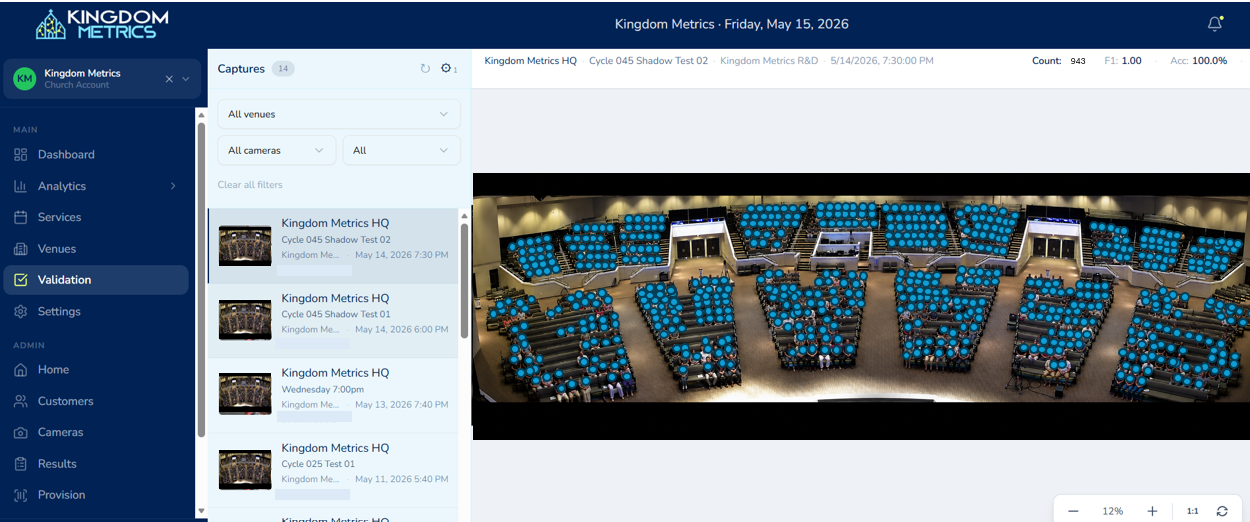
Church service attendance counting has been part of church life for as long as churches have existed — a deacon with a clicker, an estimate from the stage, a section-by-section head count. Automated systems made it easier. But none of them gave churches something they'd never had: a way to actually verify the number.
A Church People Counter You Can Actually See
Search "church people counter" and you mostly find doorway sensors — a beam at the entrance that clicks up as bodies cross it and nets entries against exits. They tell you how many crossed a line, never who was actually in the room, and you can't check their work. Kingdom Metrics does church people counting differently: one camera sees the whole sanctuary, the AI counts everyone in the seats, and your staff can open the photo and confirm every count. It's a people counter you can verify — not a black box at the door.
What "Ground Truth" Means for Church Service Attendance Counting
In data science, ground truth is the verified, confirmed answer — the number a human looked at and said, yes, that's right. For attendance, it means knowing the count isn't just a system's best guess. It's a number someone on your staff can stand behind.
Manual counting came close — when a deacon walked every row, the count reflected what they actually saw. But it was slow, inconsistent, and dependent on whoever showed up to count that week. Automate the counting and you gain consistency, but you lose the one thing the manual process had: a human who looked at the room. That gap is also where attendance bias creeps in — estimates drift, and nobody can prove by how much.